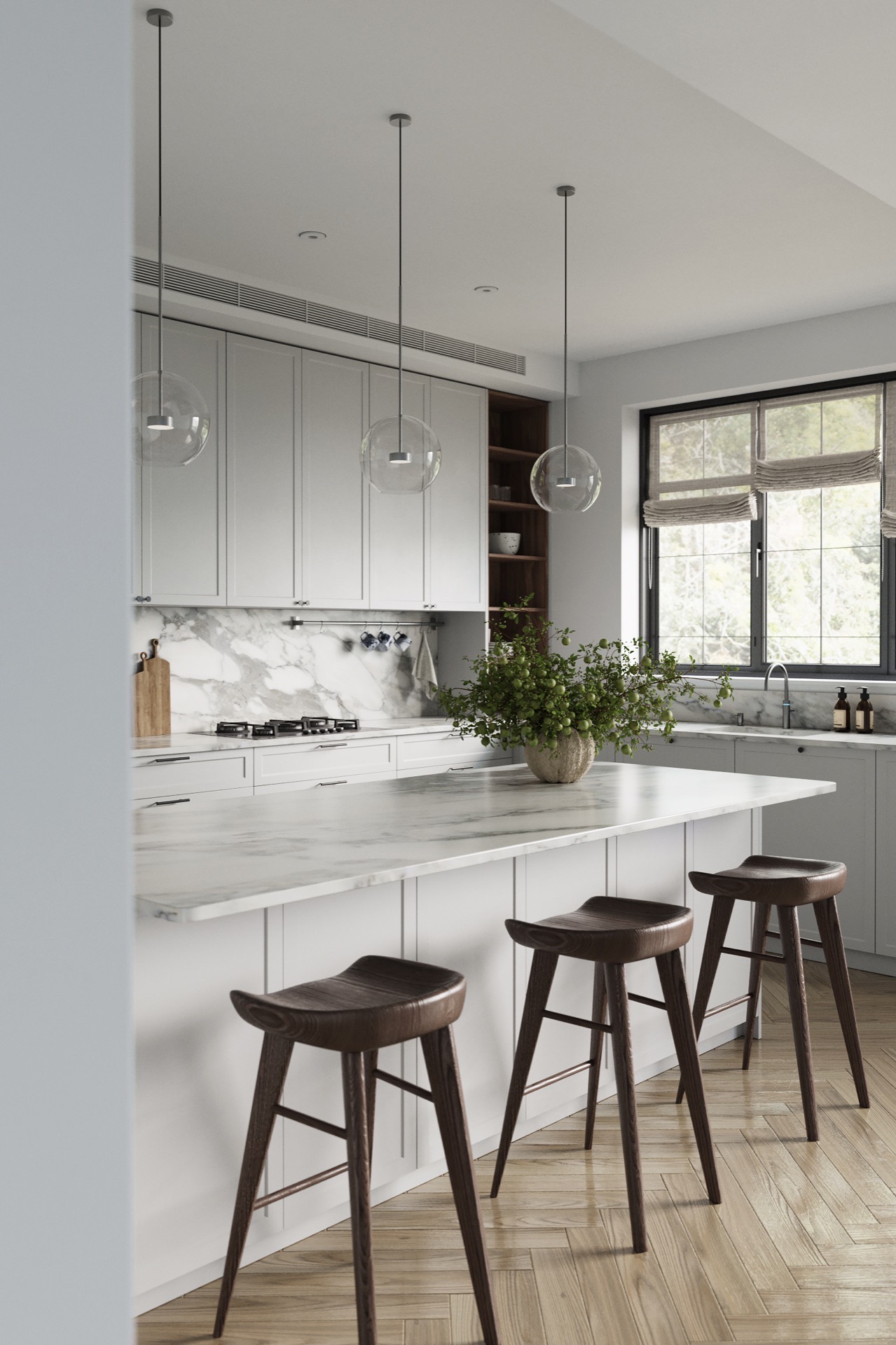
A HausBespoke kitchen is planned around the room, the building, and the way you cook. We design and manufacture handmade kitchen cabinetry for London homes, from Shaker kitchens in period properties to calm contemporary kitchens with handleless doors, concealed appliances, and tailored storage.
Kitchen design that starts with the room
London kitchens rarely arrive as clean rectangles. Period walls lean, extensions meet older floors, chimney breasts interrupt tall storage, and services often sit exactly where a standard cabinet catalogue would prefer they did not. We begin with those realities rather than hiding them. The first design pass looks at circulation, appliance runs, prep zones, dining habits, and how natural light moves through the day.
That practical work sits alongside proportion and mood. A handmade kitchen should feel settled in the architecture, whether the brief is a painted Shaker kitchen for a family house, a minimalist island for an open-plan apartment, or a warm timber kitchen with a breakfast pantry and coffee station. We use samples, drawings, and clear options so decisions feel confident rather than theatrical.
Made to measure cabinetry
Every cabinet is made to measure, which lets us tune height, depth, reveal lines, internals, and awkward junctions instead of filling gaps with dead panels. Tall housings can align with ceiling details, drawers can be built around the things you actually store, and islands can be scaled for both cooking and conversation. The result is a kitchen that earns its footprint every day.
Manufacturing in Britain gives the process discipline. Technical drawings are signed off before production, materials are ordered against the final specification, and each run is built with the installation sequence in mind. We think through access, delivery, protection, and final adjustment before components arrive on site, because a precise kitchen still has to survive the realities of a live home.
Finishes, appliances, and worktops
The right finish depends on how the kitchen will be used. Spray-painted MDF gives a refined surface and can be repaired in future, veneer adds depth and grain, melamine faced boards can be highly practical in utility zones, and solid timber brings weight and tactility when the design calls for it. We explain the maintenance trade-offs clearly so the choice lasts beyond the first photograph.
Appliances, sinks, taps, worktops, lighting, and ventilation are coordinated early. A boiling-water tap changes cabinet internals, an integrated extractor changes wall units, and a stone worktop affects support and joint positions. By resolving those details as part of the joinery design, the finished kitchen feels clean and intentional rather than assembled from separate decisions.
From survey to installation
A typical project moves from consultation to measured survey, design development, technical drawings, manufacture, delivery, and installation. We keep each stage visible so you know what is being decided and when. If building work is happening at the same time, we coordinate with contractors around first fix services, plastering, flooring, templating, and appliance delivery.
The final fit is treated as craft work, not just assembly. Scribes, plinths, hinges, runners, panel joints, and touch-ups are checked against the agreed drawings and the reality of the room. After handover, you have a clear record of what was built and how to care for it, so the kitchen can be maintained properly over time.
Questions clients ask
Do you make kitchens for period London homes?
Yes. We regularly design around uneven walls, chimney breasts, tall ceilings, older services, and conservation-led details. A measured survey and technical drawings help us make the cabinetry fit the building rather than forcing standard sizes into it.
Can you integrate appliances and worktops?
Yes. We coordinate appliance housings, ventilation, sinks, taps, lighting, and worktop templating as part of the kitchen design so the finished room works as one system.
Further reading: How much does a bespoke kitchen cost in London?, Shaker kitchen ideas for London homes, Green kitchen ideas, Handleless kitchens: pros, cons, and cost, Spray-painted vs hand-painted cabinets